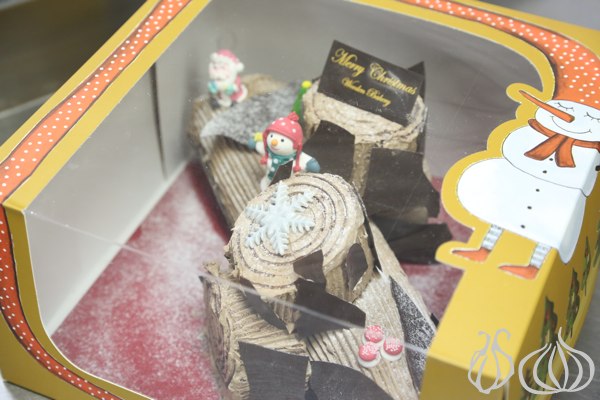

















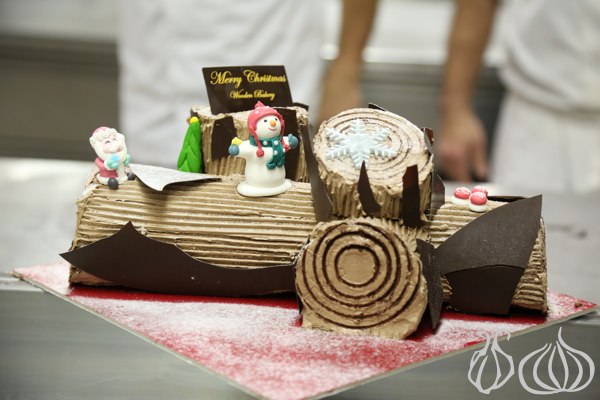
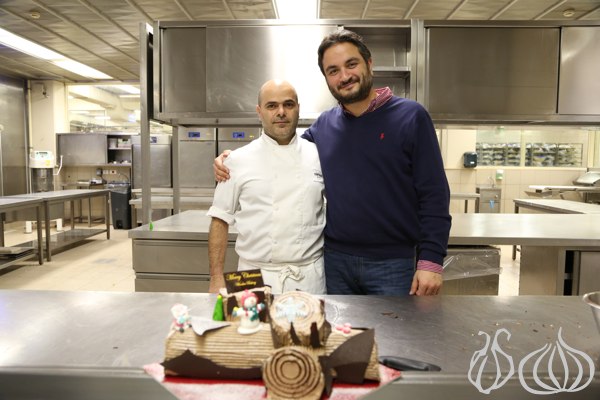
The making of a Buche de Noel... Have you ever wondered how the make them? I have. I headed down to Wooden Bakery's central kitchen where I met Chef Henry who took me on a journey of preparing the popular Christmas treat. Wooden Bakery, Lebanon's biggest bakery, produces more than 5000 logs in just two days, every year. Let's see together how they do it.
A�yule log�or�b�che de No�l�is a traditional dessert served near Christmas, especially in�France�and several other�francophone�countries and former�French colonies. It can be considered a type of sweet�roulade.
 The traditional�b�che�is made from a�genoise�or other�sponge cake, generally baked in a large, shallow�Swiss roll�pan, frosted, rolled to form a cylinder, and frosted again on the outside. The most common combination is a basic yellow sponge cake, frosted and filled with�chocolate�buttercream; however, many variations on the traditional recipe exist, possibly including chocolate cakes,�ganache�and�espresso�or otherwise-flavored�frostings�and�fillings.
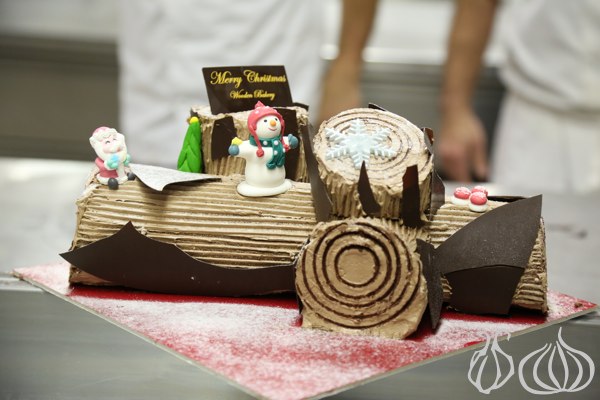
B�ches are served with a portion of one end of the cake cut off and set on top of the cake or protruding from its side to resemble a chopped off branch, and�bark-like texture is produced in the buttercream for further realism. This is done by dragging a fork through the icing. These�cakes are decorated�with�powdered sugar�to resemble�snow, tree branches, fresh�berries, and�mushrooms�made of�meringue.
The traditional�b�che�is made from a�genoise�or other�sponge cake, generally baked in a large, shallow�Swiss roll�pan, frosted, rolled to form a cylinder, and frosted again on the outside. The most common combination is a basic yellow sponge cake, frosted and filled with�chocolate�buttercream; however, many variations on the traditional recipe exist, possibly including chocolate cakes,�ganache�and�espresso�or otherwise-flavored�frostings�and�fillings.
B�ches are served with a portion of one end of the cake cut off and set on top of the cake or protruding from its side to resemble a chopped off branch, and�bark-like texture is produced in the buttercream for further realism. This is done by dragging a fork through the icing. These�cakes are decorated�with�powdered sugar�to resemble�snow, tree branches, fresh�berries, and�mushrooms�made of�meringue.
 The name�b�che de No�l�originally refers to the�yule log�itself, and was transferred to the dessert only after this custom had fallen out of use, presumably during the first half of the 20th century. It is attested in 1945 as referring to the cake.�The cake recipe itself is older, and known to date to the 19th century. The Yule Log Cake can date back as far as Europe�s Iron Age. Records indicate that even before the medieval era, people would gather in the end of December to welcome Winter Solstice. This would mark the end of winter season, and people would celebrate the days getting longer. To welcome the new year and relieve the air of last year�s events, families would burn logs that were garnished in holly, pinecones, or ivy. They would then keep the ashes from this log as they were said to be good luck and would protect against lightning.
The traditional�b�che�is made from a�genoise�or other�sponge cake, generally baked in a large, shallow�Swiss roll�pan, frosted, rolled to form a cylinder, and frosted again on the outside. The most common combination is a basic yellow sponge cake, frosted and filled with�chocolate�buttercream; however, many variations on the traditional recipe exist, possibly including chocolate cakes,�ganache�and�espresso�or otherwise-flavored�frostings�and�fillings.
B�ches are served with a portion of one end of the cake cut off and set on top of the cake or protruding from its side to resemble a chopped off branch, and�bark-like texture is produced in the buttercream for further realism. This is done by dragging a fork through the icing. These�cakes are decorated�with�powdered sugar�to resemble�snow, tree branches, fresh�berries, and�mushrooms�made of�meringue.
The name�b�che de No�l�originally refers to the�yule log�itself, and was transferred to the dessert only after this custom had fallen out of use, presumably during the first half of the 20th century. It is attested in 1945 as referring to the cake.�The cake recipe itself is older, and known to date to the 19th century. The Yule Log Cake can date back as far as Europe�s Iron Age. Records indicate that even before the medieval era, people would gather in the end of December to welcome Winter Solstice. This would mark the end of winter season, and people would celebrate the days getting longer. To welcome the new year and relieve the air of last year�s events, families would burn logs that were garnished in holly, pinecones, or ivy. They would then keep the ashes from this log as they were said to be good luck and would protect against lightning.